The Way this came to be
The Politics of Belonging
Located in LaPlace, Louisiana, about half a mile from the Mississippi River, the Woodland Plantation Museum & Cultural Center sits within a low-rise residential neighborhood but was once part of an approximately 2,000-acre sugar plantation established in the late eighteenth century by Colonel Manuel Andry. Bounded today by East Fifth Street and nearby railroad tracks, the site includes the former plantation house, constructed in 1793.
After the house was vacated in 2005, the property endured more than a decade of neglect. In 2017, the structure was rehabilitated, and from 2021 to 2022 it operated as a museum commemorating the life and legacy of Kid Ory. In 2024, Woodland Plantation was acquired by The Descendants Project, a nonprofit environmental justice organization committed to preserving the site and reinterpreting its history through the intertwined legacies of the 1811 German Coast Uprising, Kid Ory, and the region’s broader social and environmental history.
The museum’s grounds have since expanded to include the adjacent property at 1116 LA-Hwy 628, adding a neighboring parcel with a mid-century residence and more than two acres of land to Woodland’s broader footprint and future vision.
The museum, if it is to survive its own history, must become a site of radical hospitality. A place where people can enter without fear. A place that knows how to hold the trembling. A place where guests know they’ve entered into homecoming. Because hospitality is not the nicety of welcome. It is the politics of belonging. It asks: Who do we make room for? Who do we center? Who do we protect? It reminds us that curation is not only about objects or ideas … it is about making the world safe for tenderness.
What follows is the manifesto, written from the future we have already imagined and are already building. It is a record of care in the midst of collapse. It is a map toward the otherwise.
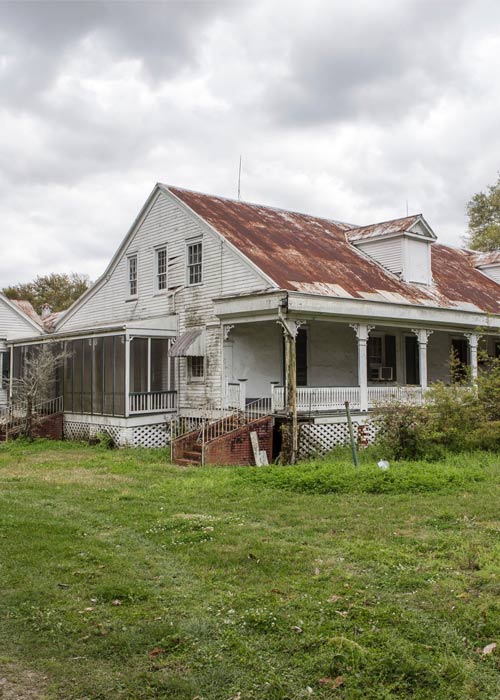
Pre-restoration photo after years of neglect
Digging in
Curatorial Manifesto
Written from the future we have already imagined and are already building.
Radical Hospitality
A place where people can enter without fear. A place that knows how to hold the trembling. A place of homecoming.
Trauma Informed Policy
The histories held here are not abstract. They live in bodies, families, and landscapes.